- Best for
- Rentals, small rooms, calm palettes
- Time
- An afternoon
- Difficulty
- Easy — no rewiring
- Total cost
- £180–£320
Why three light sources beat one
A single overhead bulb pushes the same flat light into every corner of a room. Faces look tired. Texture disappears. The room feels like a lift. Three lower light sources at different heights — a floor lamp, a table lamp, and a small accent — do something a single bulb can't: they create contrast. The eye reads the dark patches between the pools of light as depth, and the room feels larger and calmer than it actually is. This is the single change with the biggest visual return on a small room budget.
Designers call this "layered lighting" and it has three formal layers — ambient (the overall fill), task (where you read, eat, work), and accent (the decorative bit). You don't need to think in those terms to do it well. Just remember: three sources, three heights, all warm.
Layer 1 — Ambient: what to do with the overhead
The overhead is rarely doing you any favours. In a rental you usually can't replace the fixture, but you can replace the bulb, and you can put the switch on a smart plug or a corded dimmer. Three options, in order of how much we like them:
- Plug-in dimmer (£12) — only works on a lamp, not a wired ceiling fixture. Skip this for the overhead unless your fixture is on a chain.
- Smart bulb (£14, our pick) — replaces the bulb in place. Pair with a phone or a cheap battery-powered switch. We use ours at 30% in the evening, 80% in the morning.
- Don't use it at all — leave the overhead off and let the lamps do the work. This is what we do four nights out of five.
Whichever you pick, the bulb itself matters more than the fixture. Use 2700K, 60W-equivalent or lower, with a CRI ≥ 90 if you can find one. Ours came in a pack of three for under £20 and the difference vs the supermarket bulbs was visible from across the room.
Layer 2 — Task: the lamps you actually use
Two task lamps, both warm, both on dimmers if possible. A floor lamp behind the sofa to throw light over your shoulder for reading, and a table lamp on a low surface for the rest of the time. Specifics from our flat:
- Floor lamp — a 150 cm arc with a brushed-brass arm, parked behind the right armrest of the sofa. The shade sits about 110 cm above the seat — high enough to clear a head, low enough to feel like a reading light. Cost: £89.
- Table lamp — a small ceramic lamp with a linen shade, on the low oak side table. About 40 cm tall total. Same warm bulb. Cost: £42.
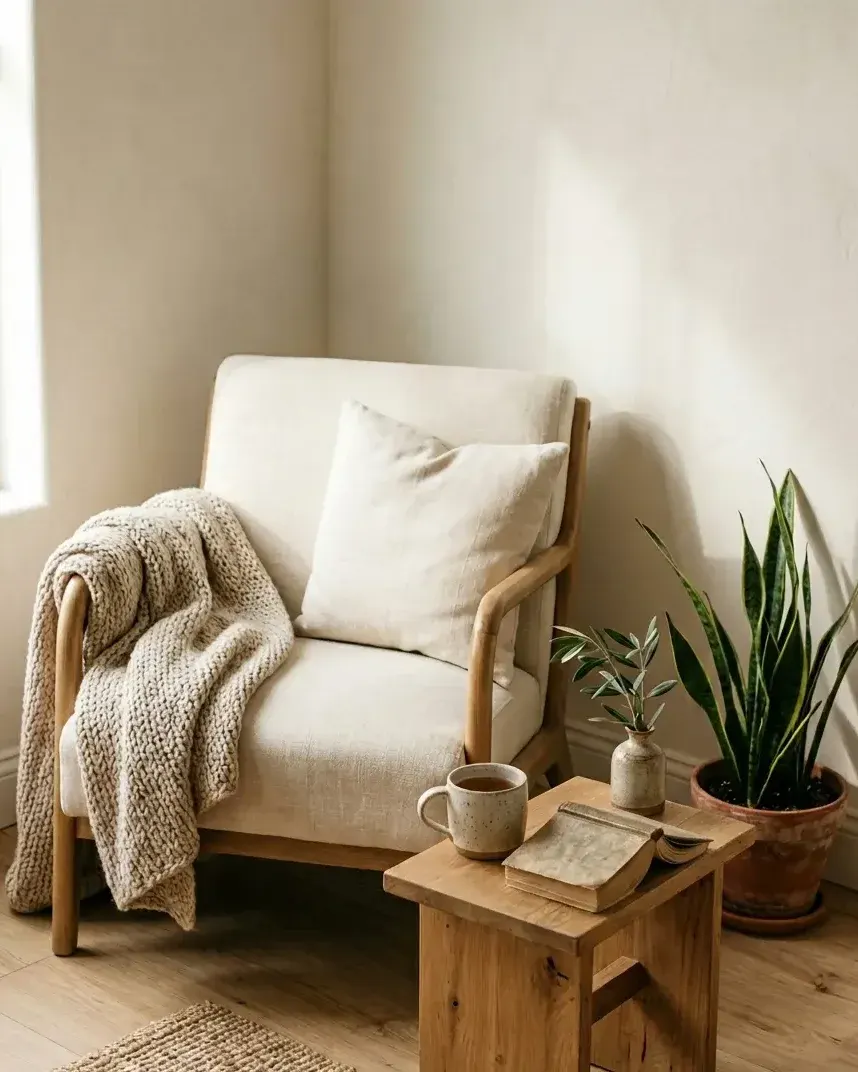
Layer 3 — Accent: the bit nobody thinks of
Accent light is the part you'll be proudest of and the one your friends will compliment without knowing why. This is a small, unexpected light source — a candle, a battery-powered LED in a vase, a single picture light, a bud-vase-sized lamp on a windowsill. It doesn't do useful work; it does atmospheric work.
We tried four things before we found one that stuck:
What worked
- A single rechargeable LED candle on the windowsill, on a 6-hour timer
- A small clip-on picture light over the framed print above the sofa
- Fairy lights inside a clear glass demijohn (sounds twee, looks excellent)
What didn't
- String lights along the ceiling line — felt like a teenager's dorm
- Plug-in wall sconce with a cord cover — too much hassle for too little payoff
- Salt lamp — beautiful in theory, weirdly orange on the wall in practice
The bulbs and the dimmers (the bit we got wrong first time)
The single biggest mistake was putting different colour-temperature bulbs in the three lamps. The first floor lamp came with a 3000K bulb, the table lamp had a 2700K, and the candle was 2200K. Watching one room with three different "whites" is a strange, slightly seasick experience. Match them. Buy a six-pack of identical 2700K bulbs and use them everywhere.
| Item | Spec | Cost |
|---|---|---|
| Floor lamp | 150 cm arc, brushed brass | £89 |
| Table lamp | Ceramic base, linen shade | £42 |
| Smart bulb (overhead) | 2700K, dimmable, app-controlled | £14 |
| Pack of warm bulbs | 2700K, CRI 90, 6-pack | £18 |
| LED candle on windowsill | Rechargeable, 6-hour timer | £12 |
| Picture light (clip-on) | Battery, brushed brass | £24 |
| Total | £199 | |
You can do a lighter version of this for about £180 if you skip the picture light, or push it to £320 with a nicer floor lamp. We've seen both ends. The £199 version is what most people will see when they walk in.
What we'd change if we did it again
Three things, in order of how much they would matter:
- Buy the bulbs first, then the lamps. Two of our lamps came with shades that were too thick for the bulbs we wanted to use. We had to swap shades, which was a small annoying expense.
- Don't put a lamp on a tall surface. The first table lamp we bought sat on a 75 cm console table, which put the shade at eye level when standing. Glare is the enemy of mood. Lamp shades should be roughly at the height of your head when seated — never higher.
- The dimmer is non-negotiable. A non-dimmable lamp at 9pm in winter is wrong by a factor of two. If you have to choose between a dimmable lamp at £42 and a fixed lamp at £30, pay the £12.
Frequently asked
How many lamps do I really need in a small living room?
Three is the minimum for the layered look — one ambient (overhead or replacement), one task (floor or table), and one accent (candle, picture light). Two will work if you really cannot fit three; one will not.
Can I do this in a rental without rewiring?
Yes — everything in this guide is plug-in or bulb-swap. No fixtures need replacing, no wiring is touched. Take the bulbs with you when you move.
What colour temperature should the bulbs be?
2700K for living rooms in the evening. 3000K is fine in the morning. Anything above 3500K (so most "cool white" supermarket bulbs) is too clinical for a sitting area. Match all bulbs in the room — never mix temperatures.
Will three lamps make my electricity bill go up?
Trivially. Three 9W LEDs on for four hours a night is roughly 0.1 kWh — about 3 pence on a UK tariff. Less than one cup of tea per day.